
Code: solidCivil Engineering3rd Semester6 Examination Papers

Introduction to Solid Mechanics

Official Bihar Engineering University examination question papers, marks distribution, and questions transcript. Available exam sessions: 2025, 2023, 2022, 2019, 2018, 2017.

Exam Year:

Get Instant AI Answers on this Paper

Open BEU Connect Android app to solve any numerical or derive formulas step by step.

Ask AI in App
Official Exam Paper TranscriptB.Tech 3rd Semester Examination, 2025
Bihar Engineering University, Patna
B.Tech 4th Semester Exam., 2025

Introduction to Solid Mechanics

Time: 03 HoursCode: 101405Semester: IVFull Marks: 70

Instructions:

  1. The marks are indicated in the right-hand margin.
  2. There are NINE questions in this paper.
  3. Attempt FIVE questions in all.
  4. Question No. 1 is compulsory.
Q.1 Choose the correct option / answer the following (Any seven question only):[2 x 7 = 14]
  1. For a simply supported beam with central point load P, the maximum bending moment occurs at

    1. Support
    2. Quarter span
    3. Midspan
    4. Wherever shear force is maximum
  2. A solid circular shaft transmits torque T with shear stress τ. If its diameter is doubled, the torque capacity becomes

    1. 2T
    2. 8T
    3. 4T
    4. 16T
  3. Point of contraflexure in a beam is a point where

    1. Shear force is zero
    2. Bending moment changes sign
    3. Load is maximum
    4. Bending moment is zero
  4. Shear stress across a rectangular beam section is maximum at

    1. Neutral axis
    2. Bottom
    3. Top
    4. Both top and bottom
  5. In a thin cylindrical vessel under internal pressure, the hoop stress acts

    1. Along the length
    2. Along the circumference
    3. Radially outward
    4. Radially inward
  6. A composite bar made of steel and copper is heated. The stresses induced are due to

    1. Equal modulus of elasticity
    2. Difference in coefficients of thermal expansion
    3. Equal thermal strain
    4. Equal Poisson's ratio
  7. For a thin cylinder under internal pressure, the longitudinal stress is

    1. Equal to hoop stress
    2. Twice hoop stress
    3. Half hoop stress
    4. Zero
  8. Hooke's Law is valid only within

    1. Plastic limit
    2. Yield point
    3. Elastic limit
    4. Ultimate point
  9. The ratio of lateral strain to longitudinal strain is called

    1. Elastic modulus
    2. Bulk modulus
    3. Poisson's ratio
    4. Shear modulus
  10. In a 2D stress system, the planes on which the shear stress becomes zero are known as

    1. Strain planes
    2. Principal planes
    3. Yield planes
    4. Critical planes
Q.2 Solve both questions :[7 x 2 = 14]
  1. Explain Hooke's law and its application to stress and strain for elastic materials.

  2. Derive the bending equation M/I=E/R=σ/y.

Q.3 Solve both questions :[7 x 2 = 14]
  1. Calculate the values of the stress and strain in portions AC and CB of the steel bar shown in Figure. A close fit exists at both of the rigid supports at room temperature and the temperature is raised by 75°C. Take E = 200 GPa and α = 12 × 10-6 /°C for steel. Area of cross sections of AC is 400 mm² and of BC is 800 mm².
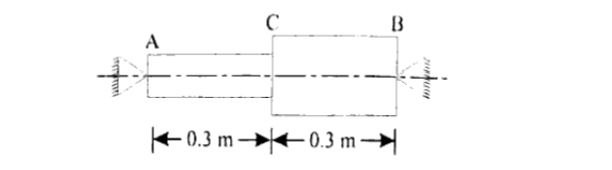
    Question Diagram
  2. A C.I. flat, 300 mm long and of 30 mm × 50 mm uniform section, is acted upon by the following forces uniformly distributed over the respective cross-section: 25 kN in the direction of length (tensile); 350 kN in the direction of the width (compressive); and 200 kN in the direction of thickness (tensile). Determine the change in volume of the flat. Take E = 140 GN/m², and m = 4.

Q.4 Solve both questions :[7 x 2 = 14]
  1. A straight uniform bar AD is clamped at both ends and loaded as shown in Figure. Initially the bar is stress free. Determine the stresses in all the three parts (AB, BC, CD) of the bar if the cross-sectional area of bar is 1000 mm².
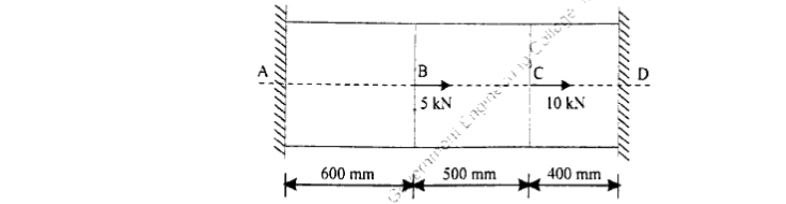
    Question Diagram
  2. Explain the different types of loads and beams with neat sketch. Also state Point of contraflexure.

Q.5 Solve both questions :[7 x 2 = 14]
  1. Draw the S.F. and B.M. diagrams for the cantilever loaded as shown in the figure.

    Question Diagram
  2. State and explain Circumferential and longitudinal stress in thin cylinder.

Q.6 Solve both questions :[7 x 2 = 14]
  1. Draw the S.F. and B.M. diagrams for simply supported beam loaded as shown in Figure.
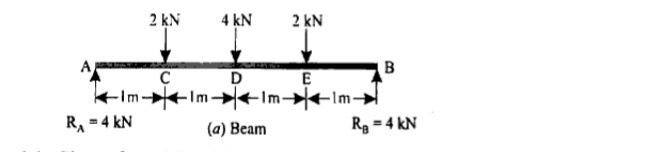
    Question Diagram
  2. State and explain Circumferential and longitudinal stress in thin cylinder.

Q.7 Solve both questions :[7 x 2 = 14]
  1. Derive and state the comparison of Hollow and solid shaft by strength.

  2. A beam simply supported at ends and having cross-section as shown in Figure is loaded with a U.D.L., over whole of its span. If the beam is 8 m long, find the U.D.L. if maximum permissible bending stress in tension is limited to 30 MN/m² and in compression to 45 MN/m². What are the actual maximum bending stresses set up in the section?
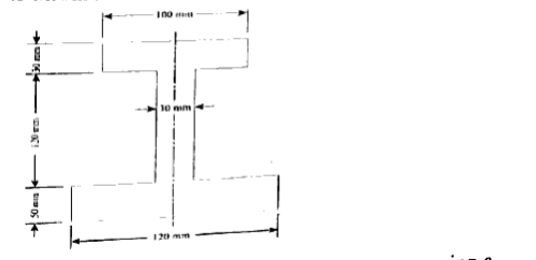
    Question Diagram
Q.8 Solve both questions :[7 x 2 = 14]
  1. Derive the expression of S.F and B.M. for a simply supported beam carrying a concentrated load at mid span. Also draw S.F. & B.M. diagram.

  2. A hollow shaft of diameter ratio 3/8 is required to transmit 600 kW at 110 r.p.m., the maximum torque being 20% greater than the mean. The shear stress is not to exceed 63 MN/m² and the twist in a length of 3 m not to exceed 1.4 degrees. Calculate the maximum external diameter satisfying these conditions. Take: C = 84 GN/m².

Q.9 Write short note on any two of the following:[7 x 2 = 14]
  1. Stress- Strain curve for mild steel.

  2. St. Venant's Principle.

  3. Moment area Method.

  4. Elastic Moduli.

Related Official Syllabus

Solid Mechanics

101301

Official BEU curriculum units & topics for this examination subject.

Subject name matches ('Solid Mechanics'), but PYQ code is 'solid' / papers [101405, 011406] vs Syllabus code '101301'.

Unit 1.0: Simple Stresses and Strains

Concept of stress and strain • St. Venant's principle • Stress and strain diagram • Elasticity and plasticity • Types of stresses and strains • Hooke's law • Stress-strain diagram for mild steel • Working stress • Factor of safety • Lateral strain • Poisson's ratio and volumetric strain • Elastic moduli and the relationship between them • Bars of varying section • Composite bars • Temperature stresses • Strain Energy • Resilience • Gradual, sudden, impact and shock loadings • Simple applications

Unit 2.0: Compound Stresses and Strains

Two dimensional system • Stress at a point on a plane • Principal stresses and principal planes • Mohr circle of stress • Ellipse of stress and their applications • Two dimensional stress-strain system • Principal strains and principal axis of strain • Circle of strain and ellipse of strain • Relationship between elastic constants

Unit 3.0: Bending moment and Shear Force Diagrams

Bending moment (BM) and shear force (SF) diagrams • BM and SF diagrams for cantilevers simply supported and fixed beams with or without overhangs • Calculation of maximum BM and SF and the point of contra flexure under concentrated loads • Uniformly distributed loads over the whole span or part of span • Combination of concentrated loads (two or three) and uniformly distributed loads • Uniformly varying loads • Application of moments

Unit 4.0: Flexural Stresses

Theory of simple bending • Assumptions • Derivation of bending equation: M/I = f/y = E/R • Neutral axis • Determination of bending stresses • Section modulus of rectangular and circular sections (Solid and Hollow) • I, T, Angle and Channel sections • Design of simple beam sections

Unit 5.0: Shear Stresses, Slope and Deflection

Shear Stresses: Derivation of formula • Shear stress distribution across various beam sections like rectangular, circular, triangular, I, T angle sections • Slope and deflection: Relationship between moment, slope and deflection • Moment area method • Macaulay's method • Use of these methods to calculate slope and deflection for determinant beams

View Complete 3rd Semester Syllabus

Prepare Better with BEU Connect

  • Download papers for 100% offline study
  • Ask AI for step-by-step problem breakdown
  • Attempt official GATE CBT mock tests
  • Calculate SGPA and track attendance
Download Android App