
ELECTRICAL CIRCUIT ANALYSIS
Instructions:
- The marks are indicated in the right-hand margin.
- There are NINE questions in this paper.
- Attempt FIVE questions in all.
- Question No. 1 is compulsory.
Thevenin's and Norton's equivalents are:
Mesh analysis is preferred when:
The steady-state response in a circuit is observed:
In a critically damped RLC circuit, the roots of characteristic equation are:
The admittance of an inductor is:
The average power in a purely capacitive circuit is:
Poles are values of 's' where:
Convolution in time domain becomes……… in Laplace domain:
A network is reciprocal if it contains only:
The h-parameters are mainly used for:
State Maximum Power Transfer Theorem. Prove that efficiency of the circuit under maximum power transfer condition is 50%.
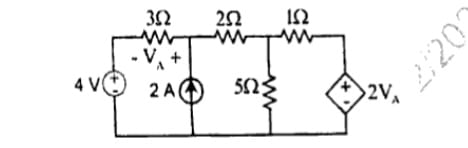
Find the voltage across 3Ω resistor using any theorem for the circuit shown in Figure-1

Find VA using the principle of superposition in network as shown in Figure 2.
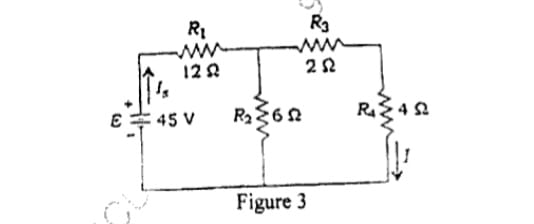
State Reciprocity Theorem. Verify the Reciprocity Theorem for the circuit shown in Figure 3.
Explain the behaviour of RL and RC elements for transient condition. Mention their representation at the time of switching.
Draw the circuit of parallel RLC circuit and derive the formulae for resonant frequency, half-power frequencies, bandwidth and quality factor.
Determine Laplace transform of a following (i) sin2t (ii) cos2t
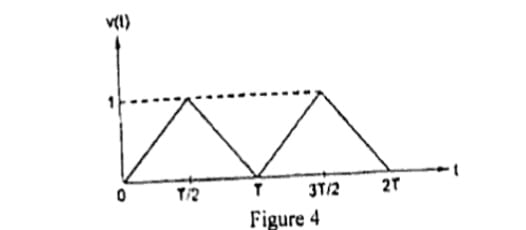
Synthesis the waveform shown in Figure 4 below and Determine Laplace transform of periodic waveform.
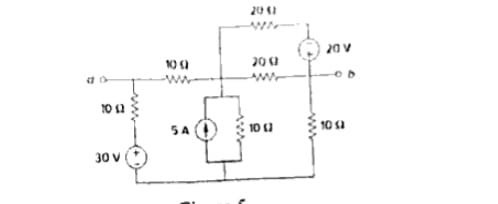
To find Thevenin equivalent between terminals 'a' and 'b' as shown in Figure 5.
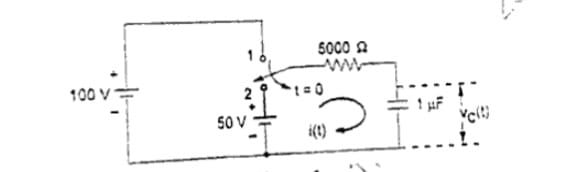
A switch is moved from position 1 to 2 at t=0 as shown in Figure 6. Find VR(t) and VC(t) for t>0.
Explain about the transmission parameters and derive the condition for symmetry and reciprocity.
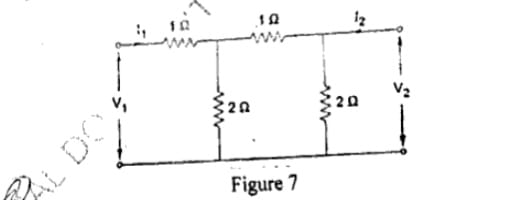
Determine z-parameter of network shown below in Figure 7 & give its equivalent circuit.
Define two-port network and write assumptions to be made to find network and also obtain Y parameter.
Two coils connected in series have an equivalent inductance of 10H. When the connections of one coil are reversed, the effective inductance is 6H. If the co-efficient of coupling is 0.6, calculate the self-inductance of each coil and mutual inductance.
Poles and Zeros
Convolution integral
Mutual coupled circuits
Transmission and Hybrid parameters